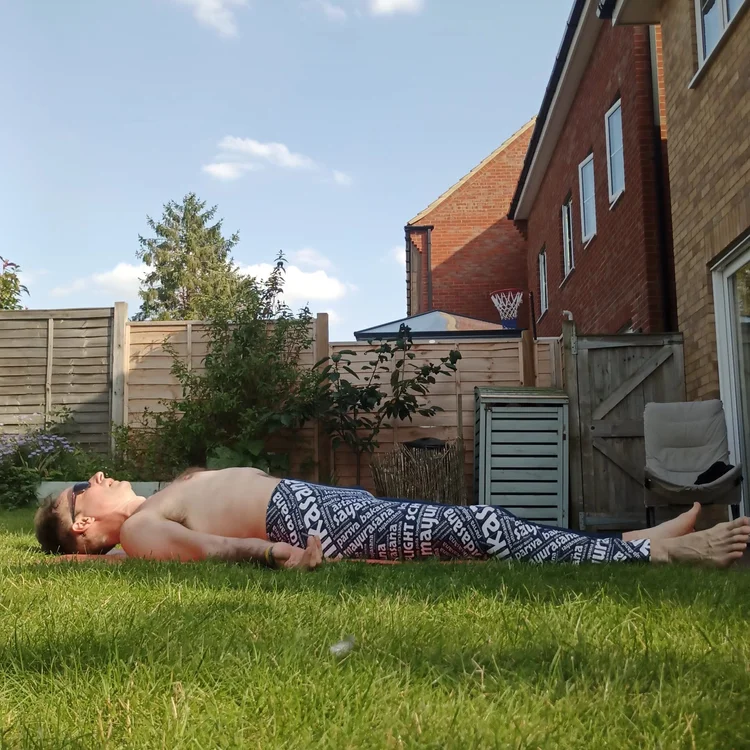
You've moved through an entire yoga class: sun salutations, warrior poses, challenging balances. Your muscles are warm, your breath is steady, and then your teacher says: "Come to Savasana."
For many people, Savasana (corpse pose) feels like an afterthought. It is just a brief rest before rushing to the next thing on their to-do list. Some students even skip it entirely, rolling up their mat and heading out as soon as the "real" yoga is done.
But here's what most people don't realize: Savasana isn't just the cooldown at the end of class. It's arguably the most important pose in your entire practice.
In our fast-paced, always-on modern world, the ability to truly rest and to consciously let go and allow your nervous system to reset is not just valuable - it's essential for your health, sanity, and survival.
What is Savasana?
Savasana, typically translated from Sanskrit to English as "corpse pose," is the final resting pose practiced at the end of most yoga classes. The physical form is deceptively simple:
- Lie on your back
- Legs extended, feet falling naturally to the sides
- Arms by your sides, palms facing up
- Eyes closed
- Body completely still and relaxed
- Breath natural and effortless
That's it. No movement, no effort, no "doing" at all. Just being.
And, that's precisely what makes it so challenging... and so powerful.
🧘 The Paradox of Savasana
Savasana is considered one of the most difficult yoga poses to master, not because it's physically demanding, but because it requires something most modern people have lost: the ability to be completely still, present, and relaxed without distraction or agenda.
The Purpose: More Than Just Rest
Savasana serves multiple essential purposes that extend far beyond simply "resting" after physical exertion:
1. Integration of Physical Practice
During an active yoga practice, you're creating microtears in muscle tissue, building strength, and improving flexibility. Your nervous system is engaged, your heart rate is elevated, and various systems in your body are activated.
Savasana gives your body time to integrate these changes. It's when the actual benefits of your practice are absorbed. It's when muscles repair, when new neural pathways solidify, when your body moves from "stress response" to "recovery mode."
2. Activation of the Parasympathetic Nervous System
Your autonomic nervous system has two modes: sympathetic (fight-or-flight) and parasympathetic (rest-and-digest). Modern life keeps most people stuck in sympathetic overdrive in a chronic stress, constant stimulation, always-on state.
Savasana deliberately activates your parasympathetic nervous system. This triggers a cascade of healing responses: lowered heart rate, reduced blood pressure, improved digestion, enhanced immune function, and tissue repair. This isn't just relaxation. It is physiological restoration.
3. Mental and Emotional Processing
Physical movement releases stored emotions and stress from your body. You may have noticed this during practice, e.g., suddenly feeling emotional during a hip opener, or experiencing a wave of energy release in a deep backbend.
Savasana gives your mind space to process these releases. It's a state of conscious relaxation where your brain can integrate not just physical changes, but emotional and psychological ones too.
4. Training Conscious Relaxation
Most people have forgotten how to relax consciously. We either collapse into unconscious sleep when exhausted, or we're in active "doing" mode. We've lost the middle ground: awake, aware, yet completely relaxed.
Savasana trains this crucial skill. You practice releasing physical tension while maintaining awareness. This is a skill you can then apply throughout your day. Wouldn't it be great to stay calm under pressure, release tension at your desk, and to fall asleep more easily at night?
5. Cultivating Non-Doing
Western culture glorifies constant activity, vainly chasing productivity. We're always doing, achieving, optimizing, improving. Even our relaxation is often goal-oriented - "I need to relax so I can be more productive tomorrow."
Savasana teaches you to simply be, without purpose or agenda. This isn't laziness. Savasana is a profound act of resistance against a culture that measures human worth by productivity. It's practicing the revolutionary act of existing without justification.
The Science Behind Savasana
Modern research confirms what yogis have known for millennia: conscious relaxation has measurable, powerful effects on your health.
What Happens During Savasana
🧠 Brain Wave Changes
Your brain shifts from beta waves (active thinking) to alpha and theta waves (relaxed, meditative states). This is associated with enhanced creativity, problem-solving, and emotional regulation.
💓 Cardiovascular Benefits
Heart rate decreases by 10-20 beats per minute. Blood pressure drops. Heart rate variability (HRV) improves. This is a key marker of nervous system health and resilience.
🧬 Cellular Repair
Growth hormone release increases, promoting tissue repair. Inflammation markers decrease. Your body shifts from "stress mode" to "repair mode" at the cellular level.
🧪 Hormonal Balance
Cortisol (stress hormone) levels drop. Serotonin and dopamine (mood-regulating neurotransmitters) increase. This is why you feel calmer and more positive after Savasana.
🛡️ Immune Function
The parasympathetic state enhances immune system activity. Natural killer cell activity increases, helping your body fight infection and disease.
📊 Research Shows
A 2018 study published in Frontiers in Human Neuroscience found that just 10 minutes of Savasana significantly reduced markers of stress and anxiety while improving feelings of calm and well-being. The effects were comparable to much longer periods of sleep.
Why Savasana Matters More Now Than Ever
We live in an age of chronic overstimulation. Consider the modern reality:
- Constant connectivity: With smartphones, emails, social media, we're always reachable, always "on"
- Information overload: We consume more information in a day than people in the 18th century did in a lifetime
- Chronic stress: With work pressure, financial anxiety, global crises, our nervous systems are in perpetual fight-or-flight
- Sleep deprivation: Despite being "always tired," most people don't get quality restorative sleep
- Burnout epidemic: Exhaustion, cynicism, and reduced efficacy are becoming the norm, not the exception
In this context, Savasana isn't a luxury. It is a necessity. It's one of the few times in your day when you're not consuming information, producing output, or responding to demands. You're simply being.
⚠️ The Cost of Never Resting
When you're always in "go mode," never allowing your nervous system to fully rest, the consequences accumulate:
- • Chronic fatigue that sleep doesn't fix
- • Anxiety and depression
- • Weakened immune system
- • Cardiovascular problems
- • Cognitive decline and memory issues
- • Emotional dysregulation and irritability
- • Physical tension and chronic pain
- • Burnout and loss of purpose
Regular practice of conscious relaxation, such as Savasana, can prevent or reverse these problems.
How to Practice Savasana Properly
While the physical form is simple, effective Savasana requires intention and practice. Here's how to do it:
Step-by-Step Guide
1. Set Up Your Space
Find a quiet place where you won't be disturbed. Lie on your back with legs extended, feet falling naturally apart (approximately mat-width). Arms by your sides, palms facing up (a gesture of receiving, not protecting). Make sure you're warm as body temperature drops during rest, so use a blanket if needed.
2. Find Symmetry
Align your body so it's symmetrical with your head centred, shoulders even, and hips level. This helps your nervous system settle. Small asymmetries can create subtle tension that prevents deep relaxation.
3. Release Physical Tension
Systematically relax each body part, starting from your feet and moving up: toes, ankles, calves, knees, thighs, hips, belly, chest, fingers, hands, arms, shoulders, neck, jaw, face, scalp. Let everything soften and sink into the ground.
4. Allow Natural Breathing
Don't try to control your breath. Let it find its own rhythm. As you relax more deeply, your breath will naturally slow and soften. Just observe it without interfering.
5. Settle Your Mind
Your mind will wander, and that's entirely normal. When you notice thoughts arising, don't fight them. Simply acknowledge them and gently return your attention to your breath or body sensations. Think of thoughts like clouds passing through the sky - observed but not engaged with.
6. Stay for At Least 5-10 Minutes
It takes time for your nervous system to shift states. Aim for at least 5 minutes, ideally 10-15. Set a gentle timer if needed so you're not worried about time.
7. Exit Slowly
When it's time to finish, don't rush. Deepen your breath, wiggle your fingers and toes, stretch gently, roll to one side in a fetal position, then slowly press yourself up to sitting. Take a moment before standing. This gradual transition honours the deep rest you just experienced.
Common Mistakes and How to Fix Them
❌ Skipping It Entirely
The mistake: Rushing out of class as soon as the active practice ends.
The fix: Recognise that Savasana isn't optional. It is when the real magic happens. Stay for the full practice, even if you need to arrive late or leave right after Savasana.
❌ Treating It Like Sleep
The mistake: Falling unconscious rather than staying in aware relaxation.
The fix: Savasana is conscious relaxation, not sleep. If you frequently fall asleep, you're probably sleep-deprived. Consider going to bed earlier, and during Savasana, maintain a thread of awareness even as your body deeply rests.
❌ Fighting Your Thoughts
The mistake: Getting frustrated when your mind wanders and trying to force it to be blank.
The fix: Thoughts are normal. The practice is noticing when you've drifted and gently returning. Each time you notice and return is a successful moment, not a failure.
❌ Making It Too Short
The mistake: Only staying for 1-2 minutes before jumping up.
The fix: Your nervous system needs time to shift gears. Minimum 5 minutes, ideally 10-15. If you're time-limited, do a shorter active practice but keep a full Savasana.
❌ Staying in Planning Mode
The mistake: Using Savasana time to mentally plan the rest of your day.
The fix: When you notice planning thoughts, acknowledge them ("I'm planning") and return to body sensations. Your to-do list and laundry pile will still be there after Savasana, but this time is for rest, not productivity.
❌ Being Physically Uncomfortable
The mistake: Lying in a way that creates tension or discomfort.
The fix: Use props! Place a bolster or folded blanket under your knees if you have lower back tension. Support your head if needed. Use an eye pillow to block light and calm your nervous system. Comfort is essential for deep relaxation.
Bringing Savasana Into Daily Life
You don't need to wait for the end of a yoga class to experience the benefits of conscious relaxation. Here's how to integrate Savasana principles throughout your day:
☕ Coffee Break Savasana
Instead of scrolling your phone during breaks, lie down for 5 minutes. Set a timer, close your eyes, and practice the same full-body relaxation. You'll return to work refreshed, not just caffeinated.
🛌 Evening Wind-Down
Practice 10-15 minutes of Savasana before bed. This signals to your nervous system that it's safe to rest, improving sleep quality dramatically.
🪑 Desk Micro-Savasana
Can't lie down? Practice "seated Savasana" at your desk: close your eyes, rest your hands in your lap, relax your shoulders, soften your face. Even 2 minutes resets your nervous system.
🧘 Weekend Deep Rest
On weekends, practice extended Savasana—20-30 minutes. This deep rest can undo a week's worth of accumulated stress and leave you genuinely restored.
The Spiritual Dimension
Beyond the physical and mental benefits, Savasana has a deeper spiritual purpose in traditional yoga philosophy.
The pose is called "corpse pose" for a reason. It's a symbolic death. It's a practice of letting go so completely that you release your identity, your worries, your story. For a few minutes, you're not a worker, parent, partner, or any role. You're not your accomplishments or failures. You're pure consciousness, pure being.
This might sound abstract, but the practice has practical effects: when you learn to let go this completely, even for moments, you cultivate a profound sense of peace that isn't dependent on external circumstances. You discover that beneath all the doing, striving, and worrying, there's a part of you that's already whole and at peace.
🙏 Ancient Wisdom
It is often said that if you can truly master Savasana, if you can be completely relaxed yet aware, surrendered yet conscious, you've mastered yoga. All the other poses are just preparation for this final resting pose.
Start Your Practice
If you've been skipping Savasana or rushing through it, consider this your invitation to reclaim it. In a world that constantly demands more—more productivity, more achievement, more optimisation, we find that Savasana is a radical act of self-care.
It's permission to stop. To rest. To simply be, without justification or purpose. And paradoxically, by allowing yourself these moments of purposeless rest, you become more effective, more resilient, and more whole in every other area of your life.
Experience Guided Savasana
Movement Prescription offers complete yoga classes that honour the importance of Savasana, with expert teachers who guide you through proper relaxation techniques. We also offer dedicated guided relaxation sessions for when you need deep rest without a full yoga class.
Whether you're new to yoga or looking to deepen your relaxation practice, you'll find classes that treat Savasana with the reverence it deserves, not just as an afterthought, but as an essential practice for modern life.
✓ Free yoga classes available • ✓ Expert instruction • ✓ Suitable for all levels
Your Challenge
For the next week, commit to 10 minutes of Savasana daily. Not as a means to an end, not to "get better at relaxing," but simply as a practice of being.
Notice what happens. Notice how difficult it might be at first to simply lie still. Notice the urge to check your phone, to get up, to do something productive. And notice, over the week, how your nervous system begins to remember what true rest feels like.
You might discover that those 10 minutes become the most valuable part of your entire day.
In a world that glorifies busyness, rest is resistance. In a culture of constant productivity, Savasana is revolution.


